
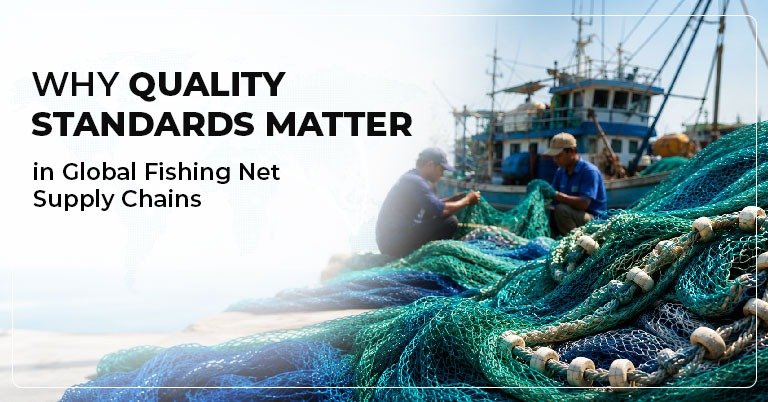
Ask any fisherman who has spent a night out on rough waters, and they’ll tell you the same thing. Their net isn’t just equipment. It’s the difference between a good catch and a wasted trip, sometimes even the difference between safety and danger at sea. Yet, in an industry that spans continents and touches millions of livelihoods, the quality of fishing nets is often overlooked until something goes wrong.
Global fishing net supply chains have grown increasingly complex over the past two decades. Raw materials are sourced from one region, nets are woven in another, and the finished product often travels thousands of miles before it reaches the hands of a fisherman on a small boat or a large trawler. At every one of these stages, quality standards quietly determine whether the final product will perform when it matters most.
The Real Cost of Poor Quality
A fishing net that fails under load doesn’t just mean a lost catch. It can mean torn gear that needs replacing mid-season, hours of repair work, or in the worst cases, injury to the crew. For commercial fishing operations, downtime caused by equipment failure translates directly into lost income. For smaller, independent fishermen, a single bad batch of netting can be the difference between profit and loss for an entire month.
Beyond the immediate financial impact, poor quality nets often shed more microplastics into marine environments and degrade faster, contributing to the growing problem of ghost gear, discarded or lost nets that continue to trap marine life long after they’ve been abandoned. Quality control, in this sense, isn’t just a business concern. It has real environmental consequences.
What Makes a High-Quality Fishing Net
1. Material Consistency Nylon, the most widely used material in modern fishing nets, needs to be manufactured with consistent tensile strength and elasticity. Variations in raw material quality can lead to nets that stretch unevenly or snap under pressure they should easily withstand.
2. UV and Weather Resistance Nets spend long hours exposed to sun, salt water, and shifting weather conditions. Without proper UV stabilization during manufacturing, fibers weaken and degrade far faster than expected, shortening the usable life of the net significantly.
3. Knot and Weave Precision The strength of a net depends heavily on how consistently it’s knotted and woven. Irregular knotting creates weak points that are often invisible to the eye but become obvious the moment real strain is applied.
4. Load-Bearing Testing Reputable manufacturers test their nets under simulated real-world conditions before they ever reach a customer. This kind of testing catches structural weaknesses that wouldn’t otherwise surface until the net is already in use.
5. Consistent Sizing and Mesh Specification Different fishing methods and target species require precise mesh sizes. A net that doesn’t meet exact specifications can result in unwanted bycatch, regulatory issues, or simply an inefficient catch.
Why Supply Chain Oversight Is So Important
Because fishing nets often pass through multiple hands before reaching the end user, from raw material suppliers to weavers to distributors, maintaining consistent quality requires oversight at every single stage. A single weak link, whether it’s substandard nylon, rushed weaving, or inadequate testing, can compromise the entire product.
This is exactly why experienced manufacturers place such heavy emphasis on tracking quality from the very first stage of production. It’s not enough to inspect the finished product. Quality has to be built in at every step, from selecting the right raw materials to monitoring tension during weaving and conducting rigorous final testing before packaging and shipment.
The Growing Demand for Reliable Standards
As global fishing operations scale up and regulations around sustainable fishing practices tighten, buyers are becoming more selective about where they source their netting. Fisheries and exporters alike are recognizing that cutting corners on quality doesn’t just risk performance. It risks compliance, reputation, and long-term business relationships.
This shift is pushing manufacturers across the industry to invest more heavily in quality assurance processes, better raw material sourcing, and transparent testing practices, giving buyers greater confidence in what they’re purchasing.
Final Thoughts
Fishing nets may seem like a simple, everyday tool, but the standards behind their production carry weight far beyond the water. Quality determines safety, profitability, and even environmental impact across the entire fishing industry.
For fishermen, exporters, and businesses looking for netting they can genuinely rely on, Babu Nylons has built a reputation on exactly this principle: consistent, tested, and dependable quality at every stage of production. With years of experience serving the global fishing community, Babu Nylons understands that a net isn’t just a product, it’s a tool that people depend on for their livelihood and safety. That’s why quality isn’t treated as an afterthought, but as the foundation of everything they manufacture.
If you’re sourcing fishing nets for your business or fleet, partnering with a manufacturer that takes quality seriously isn’t just a smart choice. It’s an investment in reliability you can count on, trip after trip.